ST. CATHARINES — A children’s play rug that city staff have used to plan St. Catharines’ road network since 1987 is nearing the end of its service life. According to a staff report going to city council next week, it will need to be replaced or restored within the next budget cycle.
The report, prepared by the city’s transportation services division, describes the rug as a “critical, single-point-of-failure asset.” It warns that fraying along the rug’s southern edge has already begun to limit planning options in several neighbourhoods.
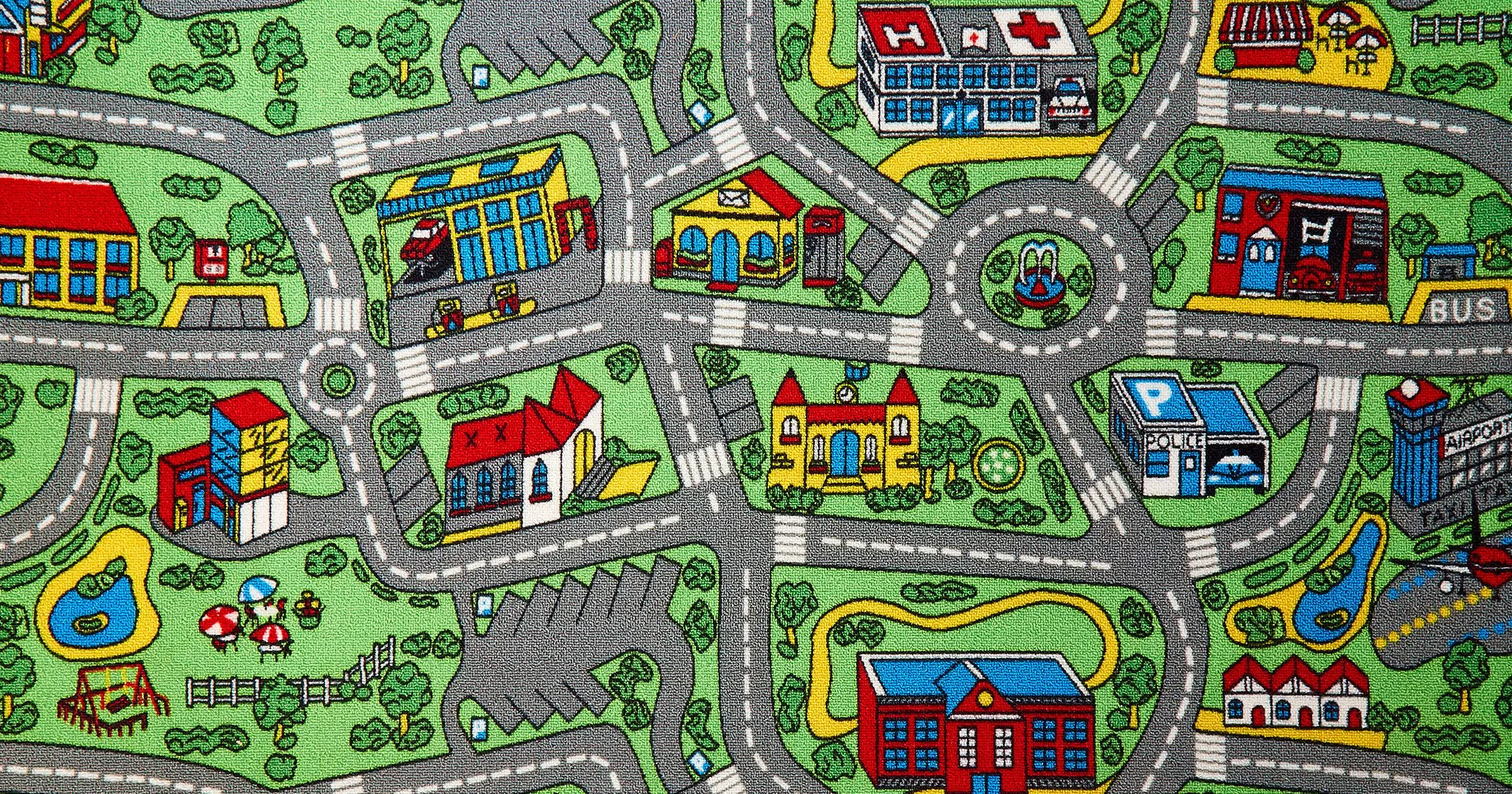
The rug is a 1.2-by-1.8-metre polyester mat printed with roads, a fire station, a school, a hospital, a bridge and a small blue pond. It was brought into the engineering office for a staff holiday party in December 1987. According to the report, it was never taken home.
“When we unrolled it, the first thing people noticed was that it already looked a lot like St. Catharines,” said Carla Brunetti, the city’s manager of transportation planning. “Nothing lined up with anything. Roads just sort of ended. So we started using it, and it held up better than most of the consultant models we’d paid for.”
A methodology refined over decades
Historians have generally credited the city’s irregular street pattern to old trails and the winding route of the first Welland Canal along Twelve Mile Creek. The report does not dispute this, but notes that nearly every road decision since 1987 “has been validated on the mat.”
Staff tested proposed intersections using die-cast toy vehicles from a plastic bin kept under the rug’s fire station. The bin held 41 cars in 1991, a figure that remains the city’s modelled peak-hour volume for Glendale Avenue.
The report’s appendices document how the rug’s condition has shaped the city over time. A 1994 apple juice spill in the northwest quadrant produced what staff still call “the wet zone.” A cluster of cul-de-sacs was approved there because “you couldn’t really drive through it.”
A section of the rug that sat beneath a filing cabinet from 1998 to 2011 received no new roads for 13 years. In 2009, the rug came back from a professional cleaning rotated 90 degrees. Staff did not notice the change for several years, and the report describes it as “consequential.”
Brunetti was asked about the Burgoyne Bridge, which, like the rug’s bridge, is white and arched. She noted that the structure is owned by Niagara Region.
“You’d have to ask them whether they have a rug,” she said.
No suitable replacement
Staff reviewed 14 play rugs currently available from major retailers and found none compatible with the existing network. Several include bike lanes. One features a train station with regular service. Another has a roundabout at nearly every intersection, which staff flagged as “not reflective of community expectations.”
The report estimates that adopting any of the new rugs would require reconstructing 60 per cent of the city’s roads to match.
It lays out three options for council:
- Replace the rug and rebuild the city accordingly.
- Hire a textile conservator in Toronto to restore the existing rug for $14,200.
- Continue using the rug as is and “formally recognize the fraying as a design constraint.”
Coun. Doug Ferrante said he would keep an open mind but had concerns about change.
“I’m not against a new rug,” Ferrante said. “But people here have learned these roads. It took them years. If we put down something with bike lanes and a train station, my mother is never going to find the Pen Centre again.”
Public input sought
The city will hold a drop-in information session at the Pen Centre on Sept. 24. Residents are invited to bring their own children’s play rugs and toy vehicles for staff to evaluate.
“My son has been driving a plastic fire truck into our couch for about two years,” said Lindsay Arruda, a Merritton parent who registered for the session. “I didn’t know that was something the city was looking for.”
Staff are recommending the restoration option. They are also recommending a high-resolution scan of the rug so it can be added to the city’s digital mapping system.
A trial scan conducted last month found a single Cheerio lodged between the rug’s school and fire station, believed to date to the late 1990s. Traffic in the area has been routed around it for more than 25 years, so staff have referred the Cheerio to the city’s Heritage Advisory Committee rather than remove it.
“Residents drive around it every day,” Brunetti said. “They just don’t know that’s what it is.”