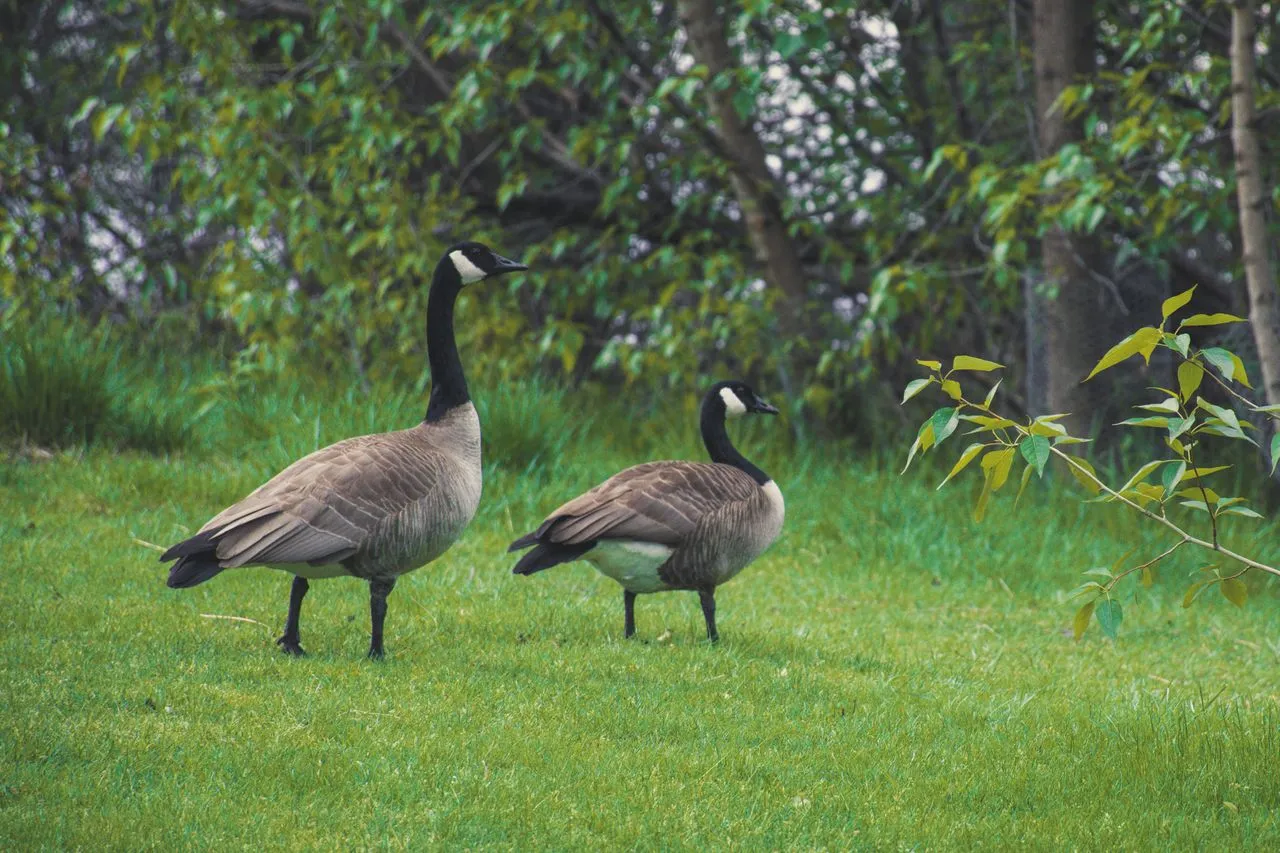
Niagara College will begin reading a formal acknowledgement of beavers before classes and public events at its Welland campus this fall, one week after Brock University began recognizing Canada geese as the original and continuing occupants of its St. Catharines campus.
The college’s statement, approved Tuesday, is one paragraph longer than Brock’s.
“We didn’t set out to make it longer,” said Derek Pasquale, Niagara College’s manager of institutional communications. “There were simply more trees to acknowledge.”
The Brock statement
Brock’s acknowledgement debuted at first-year orientation on Sept. 3 and will now be read at the start of all university events with more than 20 attendees. It follows the university’s existing land acknowledgement, which has not changed.
The statement was drafted by a 12-member working group that included two grounds staff and the author of Brock’s annual goose nesting advisory, which has asked students to yield the walkways each spring since 2015. It reads in full:
Brock University acknowledges that we gather on lands that have been home to Canada geese for thousands of years, long before the founding of this university and the construction of its first parking lot.
We recognize the geese as the original and continuing occupants of the lawns, ponds and walkways of this campus, and we honour their enduring presence here, particularly between March and June. We are grateful for their stewardship of these grounds, which is ongoing, and which takes place daily outside the main entrance.
As a university community, we commit to respecting the geese, to learning from them, and to giving them space. We invite everyone present to take a moment to reflect on their own relationship with the geese, and on the walkways we share.
“At a certain point we had to admit we were already acknowledging the geese,” said Laurel Hallworth, Brock’s associate director of campus experience. “We just weren’t doing it at orientation.”
An accompanying guidance document encourages speakers to personalize the acknowledgement in a way that is meaningful to them, and offers examples, including reflecting on a time a goose changed their route to class. Speakers are asked not to deliver it while standing on the grass during nesting season.
An earlier draft that named specific walkways was removed after the working group determined it could be read as an invitation.
Niagara College responds
Niagara College said it began drafting its own statement the day after Brock’s orientation.
“Independently,” Pasquale added.
The college’s acknowledgement reads:
Niagara College acknowledges that the Welland Campus is situated on lands and waterways that have been shaped by beavers for thousands of years.
Long before the first Welland Canal opened in 1829, beavers were building dams, managing water levels and creating wetlands throughout what is now Niagara. We honour the beavers as this region’s first engineers, and we recognize that their work continues today along the Welland River and its tributaries.
We also acknowledge the trees that have been taken in the course of this work, along local trails, riverbanks and private properties, and we recognize that their absence continues to be felt.
As a college community, we commit to learning from the beavers’ dedication, industry and hands-on approach, and to considering their interests before undertaking any work on college waterfront property. We invite all those present to reflect on the ways beavers have shaped the land beneath their feet, and the water beside it.
Pasquale said the college has a long relationship with beavers through its environmental programs, and that the animals had been active partners in several field placements, “whether or not they were aware of it.”
The college also considered acknowledging the grapevines at its Daniel J. Patterson Campus in Niagara-on-the-Lake, but set the idea aside after winery and viticulture students objected during consultation.
“The feedback was that vines are a crop, not a stakeholder,” Pasquale said. “We respect that.”
The beaver acknowledgement will be reviewed next spring, after the beavers have had an opportunity to provide feedback. Pasquale said that feedback would most likely take the form of another tree.
The moose
The situation developed further Monday, when Brock’s Senate approved an amendment adding one sentence to the end of the university’s statement:
We also acknowledge the moose, whose presence on these lands is honoured and remembered.
Moose do not live in Niagara, and the working group was unable to find any record of one on campus.
According to Hallworth, the moose arrived in a template the working group had purchased from a consulting firm that primarily serves institutions in Northern Ontario. Staff noticed it in August, after the statement had already been circulated for comment.
“There was a real discussion about taking it out,” she said. “But removing the moose at this stage would have sent the wrong message.”
Niagara College has declined to add a moose of its own.
“We are not in a position to acknowledge an animal we can’t substantiate,” Pasquale said. “We would encourage other institutions to hold themselves to the same standard.”
Interruptions
The reading of Brock’s statement at orientation was interrupted twice by geese, for a combined delay of about four minutes. Staff described the interruptions as consistent with the content of the statement.
“It was nice,” said Priya Nandakumar, a first-year kinesiology student from Brampton. “I didn’t know about the moose. I kind of want to see it now.”
Fourth-year student Evan Roszell said the acknowledgement was the first part of orientation he had attended in four years that felt accurate.
“I’ve been chased twice,” he said. “It meant something to hear the university say it out loud.”
A motion from the Brock University Students’ Union to add a badger, in recognition of the school’s athletics teams, was not adopted. The working group determined that the only badger on campus is a mascot and is employed by the university.
Niagara Region staff confirmed they have received three inquiries about whether regional council meetings in Thorold should include a goose acknowledgement. Staff will report back in the second quarter of 2027.
Asked whether Brock would remove the moose if it were confirmed that no moose had ever set foot on the campus, Hallworth said the working group had anticipated the question.
“The statement doesn’t say the moose was here,” she said. “It says we acknowledge it.”